

In short: Tretinoin is a prescription retinoid that is retinoic acid itself. Adapalene is a lab-made retinoid, sold over the counter for acne since 2016. Retinol is a cosmetic ingredient your skin converts to retinoic acid. Their FDA labels cover different things. At Increase Health, a licensed provider decides whether compounded tretinoin, which is not FDA-approved, suits you.
What is the difference between tretinoin, retinol and adapalene?
All three belong to the vitamin A family, called retinoids, but each has a different legal status. Tretinoin is a prescription drug. Adapalene is an FDA-approved acne drug, sold without a prescription at one strength since 2016. Retinol is a cosmetic ingredient: FDA doesn't approve it before sale, and it has no drug label1349.
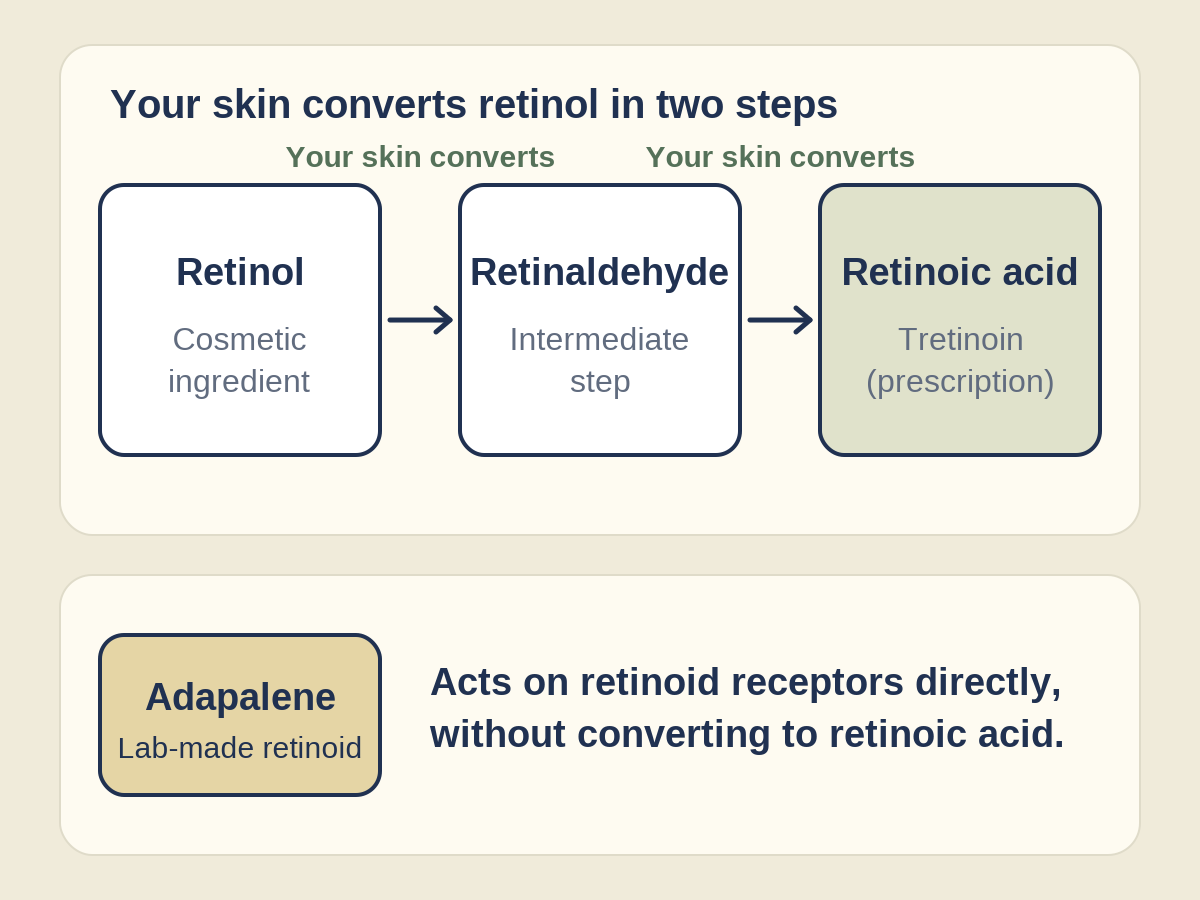
- Tretinoin is all-trans retinoic acid, the form skin cells respond to17. FDA-approved tretinoin is labelled for acne (Retin-A) or, in one product, fine facial wrinkles (Renova)12.
- Adapalene "acts on retinoid receptors", in the words of an FDA-approved adapalene label6. FDA approved the original adapalene gel for over-the-counter use in July 2016, for acne in people 12 and older. Higher strengths still need a prescription456.
- Retinol is vitamin A itself. Your skin converts it to retinaldehyde, then retinoic acid14. FDA defines a cosmetic by its purpose, such as "beautifying" or "altering the appearance", and doesn't approve cosmetics before they go on sale9.
Tazarotene, a fourth prescription retinoid, is labelled for acne and psoriasis and has the strictest pregnancy rules (see the table).
Increase Health offers compounded tretinoin, cream or gel. Compounded medications are not FDA-approved, and FDA does not review them for safety, effectiveness or quality10. The label evidence here comes from FDA-approved products, not from our formula.
Side by side
Tretinoin | Adapalene | Retinol | Tazarotene | |
|---|---|---|---|---|
Status | Prescription drug1 | OTC drug at one strength since 2016; higher strengths by prescription46 | Cosmetic ingredient; no FDA approval before sale9 | Prescription drug7 |
FDA label indication | Retin-A: "the treatment of acne vulgaris". Renova: "an adjunctive agent" for fine facial wrinkles, with sun avoidance and skin care12 | "For the treatment of acne" (12 and older)3 | No drug label; a cosmetic can't claim to treat disease or change the body's structure or function9 | Plaque psoriasis and acne vulgaris (cream)7 |
How it acts | Is retinoic acid; Retin-A says it "decreases cohesiveness of follicular epithelial cells"117 | Acts on retinoid receptors; exact mode unknown6 | A retinoid7 | |
Pregnancy | Renova: "should not be used during pregnancy", nor when "attempting to become pregnant". Retin-A: only if benefit justifies risk12 | "If pregnant or breast-feeding, ask a doctor before use"; stop and ask if you become pregnant3 | No label. AAD: "Retinoids should not be used during pregnancy"11 | Contraindicated; negative pregnancy test within 2 weeks before starting7 |
How you get it | Prescription | Over the counter, or prescription for higher strengths | Over the counter | Prescription |
At Increase Health | Compounded tretinoin if a provider prescribes it; not FDA-approved10 | Not offered | Not offered | Not offered |
Is tretinoin stronger than retinol?
Tretinoin is the active form, and your skin has to convert retinol first, so tretinoin acts more directly1314. You'll often read that it's "10 to 20 times" stronger. We traced that figure to a review sentence and lab studies of skin markers from the 1990s. No clinical study has measured a fixed multiple.
- A 2006 review says "retinol is 20 times less potent than tretinoin", citing lab studies from 1994 and 199514.
- The 1995 study covered volunteers' buttock skin for 4 days. Retinol thickened the outer skin layer about as much as tretinoin, at a much higher concentration, with almost no redness, and researchers found no measurable retinoic acid afterwards13. That's a lab marker, not a result on a face.
- A 2015 split-face trial calls the tenfold figure "theoretically considered", and its authors note "limited or no clinical studies" testing it15.
Head-to-head trials are few and small. In that 2015 trial, 65 people used a retinol formula on one side of the face and tretinoin on the other for 12 weeks; both sides improved, with no significant difference. The retinol's maker funded it and employed two of its three authors15. A 2024 systematic review of 25 studies found most alternatives to tretinoin were better tolerated, judged most of the studies poor quality or biased, and called retinoid precursors a second-line option for people who can't tolerate tretinoin17.
How does tretinoin compare with adapalene for acne?
Both are topical retinoids, a group the American Academy of Dermatology's 2024 acne guideline strongly recommends12. A 1998 pooled analysis of five trials found one adapalene gel reduced acne lesions about as well as one tretinoin gel, with less irritation. Your care team and its licensed providers will weigh your skin and history, and choose the strength.
- The pooled analysis covered 900 people with mild to moderate acne and compared one strength of each18. Its co-authors had links to adapalene's maker (see Sources).
- Label scope differs. Adapalene's labels cover acne only; tretinoin also has Renova's wrinkle label236.
- Early weeks look alike. The adapalene label warns acne "may appear to worsen before it improves" and results can take up to 3 months3. The Retin-A label describes a similar phase1. Our tretinoin starter guide covers the first weeks.
Does tretinoin help acne scars, pores or rosacea?
No FDA-approved tretinoin label lists acne scars, pores or rosacea12. The evidence is thin: one small rosacea trial, and a scar trial of a different product. If your acne is scarring, see a provider; the AAD guideline treats scarring as a reason for stronger treatment12.
- Acne scars. The clearest trial we found tested a prescription adapalene and benzoyl peroxide gel. Over 24 weeks in 67 people, the treated half of the face had fewer depressed scars than the untreated half; the maker funded it20. We found no large controlled trial of tretinoin alone for existing scars.
- Pores. No retinoid label we reviewed mentions pores1237.
- Rosacea. A 1994 trial tested tretinoin cream in 22 people with severe rosacea19. Retinoids can irritate, and our intake excludes anyone in an active, severe rosacea flare. Tell your care team if you have rosacea.
Does tretinoin help dark spots or melasma?
The Renova label says it has "NOT DEMONSTRATED A MITIGATING EFFECT" on signs of chronic sun damage, including mottled hyperpigmentation and sun spots2. The FDA-approved melasma cream that contains tretinoin also contains two other drugs and is for short-term use. Tretinoin alone has only small trials, and irritation can cause dark marks.

- The combination cream (Tri-Luma: fluocinolone, hydroquinone and tretinoin) is indicated for "the short-term treatment of moderate to severe melasma of the face", with sun avoidance, and not for maintenance8. Our compounded tretinoin is a different product.
- Two 1994 trials of tretinoin alone, each 40 weeks, one in 45 Chinese and Japanese adults with sun-related dark spots and one in 30 Black adults with melasma, reported lightening compared with a plain cream2122.
- Irritation can darken skin. The Retin-A label reports temporary darkening or lightening, and AAD says that in skin of color "irritation can trigger dark marks"111. Tell your care team if dark patches appear, and wear sunscreen daily.
Can I use any of them if I'm pregnant or trying to conceive?
Don't use tretinoin or tazarotene if you're pregnant or trying to become pregnant, and ask a doctor before using adapalene or retinol. The Renova label says not to use it when pregnant or attempting pregnancy, tazarotene's label lists pregnancy as a contraindication, and AAD says retinoids should not be used during pregnancy2711.
- Tretinoin: Retin-A's older label is softer (only if the benefit justifies the risk). We follow Renova and AAD1211.
- Adapalene: ask a doctor before use if pregnant or breastfeeding; stop and ask if you become pregnant or plan to3.
- Retinol: a cosmetic has no FDA pregnancy label9. AAD's advice on retinoids applies; ask your doctor11.
- Tazarotene: contraindicated, with a negative pregnancy test before starting7.
Our intake excludes anyone pregnant, planning a pregnancy or breastfeeding. If you become pregnant while using tretinoin, stop and contact your care team.
Is prescription tretinoin worth it over retinol?
It depends on your skin and what you want to treat. Tretinoin has FDA-approved labels for acne and fine facial wrinkles; retinol has none129. Retinol tends to irritate less, and many comparison studies are small or industry-funded1517. A licensed provider can tell you whether tretinoin suits your skin.
For fine lines, Renova's label says in capitals that it "DOES NOT ELIMINATE WRINKLES, REPAIR SUN-DAMAGED SKIN, REVERSE PHOTOAGING, or RESTORE MORE YOUTHFUL or YOUNGER SKIN"2. If tretinoin irritates your skin, your care team and its licensed providers can adjust the plan. Our guide on how to get tretinoin prescribed online explains what the visit checks and what it costs.
How do I get tretinoin through Increase Health?
Complete the skin care intake online. A licensed provider reviews your skin history and prescribes tretinoin only if it's appropriate. As of October 2026 it's $345 for 3 months, cream or gel, in one payment, charged only if a provider approves. There's no subscription. Our tretinoin is compounded and not FDA-approved.
- Complete the online intake.
- A licensed provider reviews it. You need to be 18 or older, not pregnant, planning pregnancy or breastfeeding, without an active severe eczema or rosacea flare, and willing to use daily sun protection.
- If tretinoin suits you, your care team and its licensed providers will choose the strength. If not, you pay $0.
- One payment covers 3 months; nothing auto-renews. Klarna's 4 interest-free payments are available.
- Your tretinoin ships to your door, and you can message your care team.
Compounded medications are not FDA-approved, and FDA does not review them for safety, effectiveness or quality10.
What the labels cover vs what you may read online
Concern | What FDA-approved labels say | What studies show | What you may read online |
|---|---|---|---|
Acne scars | One maker-funded trial of an adapalene and benzoyl peroxide gel, 67 people20; no large trial of tretinoin alone found | "Tretinoin fades acne scars" | |
Pores | No pore-focused trial found | "Retinoids shrink pores" | |
Rosacea | One 1994 trial, 22 people19 | "Tretinoin treats rosacea" | |
Wrinkles | Renova only: fine facial wrinkles, as an adjunct; "DOES NOT ELIMINATE WRINKLES"2 | Retinol improved fine wrinkling on the arms of 36 older adults16; comparisons with tretinoin are mostly small or industry-funded1517 | "Tretinoin reverses aging"; "retinol works as well as tretinoin" |
Dark spots, melasma | Renova: no shown effect on mottled hyperpigmentation or sun spots2. Tri-Luma: short-term melasma only8 | Two small 40-week trials of tretinoin alone2122; irritation can cause dark marks11 | "Tretinoin clears dark spots and repairs sun damage" |
What people often get wrong
- "Tretinoin is 10 to 20 times stronger than retinol." The figure comes from a review sentence and short lab studies of skin markers; no clinical study supports a fixed multiple131415.
- "Drugstore adapalene isn't a real drug." FDA approved it for acne, and it carries a Drug Facts label34.
- "Tretinoin reverses aging." The Renova label says it does not2.
- "Tretinoin fixes scars, pores and rosacea." No tretinoin label covers them12.
- "A cream is fine in pregnancy." Renova, the tazarotene label and AAD say otherwise2711.
When to get help
- Call 911 for trouble breathing or swelling of your face, lips or throat1.
- If someone swallows a retinoid product, call Poison Control at 1-800-222-12221.
- Message your care team about severe redness, burning, blistering or swelling, new dark patches, a rosacea flare, or a pregnancy. Don't use messages for emergencies.
Adelaida Estrada-Cardenas, M.S.
Chief Strategy Officer & Co-founder
Adelaida holds a Master of Science and has advanced doctoral research training from the UC San Diego School of Biological Sciences and the Salk Institute for Biological Studies. She leads patient education at Increase Health. She is a scientist, not a licensed clinician: your care team and its licensed providers will make every treatment decision.
Related treatments
For adults 18+ in eligible US states. Evaluation does not guarantee a prescription. Only approved patients receive medication; patients pay $0 if not approved. Compounded medications are not FDA-approved.

Stylized product images for marketing purposes only; they do not reflect the actual label, size or number of the prescription containers.
Sources
- 1.
DailyMed, RETIN-A (tretinoin) cream and gel label (revised March 2024)
- 2.
DailyMed, RENOVA (tretinoin cream) label (updated February 2026)
- 3.
DailyMed, DIFFERIN (adapalene) gel, OTC Drug Facts label (updated December 2022)
- 4.
- 5.
FDA, Pediatric postmarketing pharmacovigilance review: adapalene (December 2017; states the 8 July 2016 OTC approval)
- 6.
- 7.
DailyMed, TAZORAC (tazarotene) cream label (updated November 2025)
- 8.
DailyMed, TRI-LUMA cream label (updated October 2024)
- 9.
FDA, Is it a cosmetic, a drug, or both? (Or is it soap?) (September 2024)
- 10.
- 11.
American Academy of Dermatology, Retinoid or retinol? (May 2021)
- 12.
Reynolds RV et al. Guidelines of care for the management of acne vulgaris. J Am Acad Dermatol 2024
- 13.
- 14.
Mukherjee S et al. Retinoids in the treatment of skin aging: an overview of clinical efficacy and safety. Clin Interv Aging 2006
- 15.
Babcock M et al. A randomized, double-blind, split-face study comparing the efficacy and tolerability of three retinol-based products vs. three tretinoin-based products in subjects with moderate to severe facial photodamage. J Drugs Dermatol 2015. Funded by the retinol formula's maker; two authors were its employees
- 16.
Kafi R et al. Improvement of naturally aged skin with vitamin A (retinol). Arch Dermatol 2007
- 17.
Siddiqui Z et al. Comparing tretinoin to other topical therapies in the treatment of skin photoaging: a systematic review. Am J Clin Dermatol 2024
- 18.
Cunliffe WJ et al. A comparison of the efficacy and tolerability of adapalene 0.1% gel versus tretinoin 0.025% gel in patients with acne vulgaris: a meta-analysis of five randomized trials. Br J Dermatol 1998. Journal supplement on adapalene; two co-authors are listed with the maker's research center on a companion paper
- 19.
Ertl GA et al. A comparison of the efficacy of topical tretinoin and low-dose oral isotretinoin in rosacea. Arch Dermatol 1994
- 20.
Dréno B et al. Prevention and reduction of atrophic acne scars with adapalene 0.3%/benzoyl peroxide 2.5% gel in subjects with moderate or severe facial acne. Am J Clin Dermatol 2018. Funded by the maker
- 21.
Griffiths CE et al. Topical tretinoin (retinoic acid) treatment of hyperpigmented lesions associated with photoaging in Chinese and Japanese patients. J Am Acad Dermatol 1994
- 22.
Kimbrough-Green CK et al. Topical retinoic acid (tretinoin) for melasma in black patients. Arch Dermatol 1994
This guide is general information and doesn't replace advice from your care team. Label and trial findings come from FDA-approved products and study formulas, not from our tretinoin. Compounded medications are not FDA-approved; FDA does not review them for safety, effectiveness or quality.
Related articles

How to get tretinoin prescribed online
Skin Care · 7 min read

Starting tretinoin: a week-by-week guide
Skin Care · 7 min read

GLP-1s and sleep apnea: what the tirzepatide trials showed
Weight Management · 5 min read