


In short: No clinical trial has shown that GLP-1 medications extend human lifespan. The strongest human evidence is cardiovascular: in people with overweight or obesity and established heart disease, weekly semaglutide cut the relative risk of major cardiovascular events by about 20% versus placebo1. Newer work on biological aging markers and mouse lifespan is interesting and early. It is not proof that these medicines make people live longer. Compounded formulations were not the products studied in those trials.
What the strongest human evidence shows
The best human data so far is about heart risk, not years of life.
SELECT is short for Semaglutide Effects on Cardiovascular Outcomes in People With Overweight or Obesity: a large randomized trial that asked whether weekly semaglutide cuts heart attacks, strokes, and cardiovascular death in people who already have heart disease and overweight or obesity, but not diabetes1. In that trial, 17,604 adults aged 45 or older were randomly assigned to weekly subcutaneous semaglutide 2.4 mg or placebo. Over a mean follow-up of about 40 months, the semaglutide group had a 20% lower relative risk of the primary composite: cardiovascular death, nonfatal heart attack, or nonfatal stroke (hazard ratio 0.80)1.

That matters because heart disease drives a large share of illness and death. Reducing those events can support healthier years. SELECT was not designed to prove that semaglutide extends lifespan. Cardiovascular death alone did not meet the trial's threshold for superiority in the hierarchical testing plan, so lifespan claims do not follow from that result1.
Who was studied also matters. These were people who already had cardiovascular disease and a BMI of 27 or higher, not a general wellness population, and not everyone seeking weight management care.
Findings come from a trial of an FDA-approved semaglutide product. They should not be assumed to establish the safety or effectiveness of compounded semaglutide. Compounded medications are not FDA-approved, and FDA does not review them for safety, effectiveness, or quality. See our guide on compounded vs FDA-approved GLP-1s.
What early aging research shows
Scientists are also asking whether GLP-1 medicines change markers linked to biological aging. That is a different question from "do people live longer?"
A 2026 exploratory analysis looked at blood DNA-methylation (epigenetic clock) measures in adults with HIV-associated lipohypertrophy who had been randomized to semaglutide or placebo for 32 weeks. In adjusted analyses, the semaglutide group showed slower change on several second- and third-generation clocks, including about a 9% slower DunedinPACE pace-of-aging estimate versus placebo2.

Treat this as an early signal, not proof that participants became biologically younger or will live longer. The aging analysis was post hoc (not the trial's primary goal), the sample was modest, the cohort was specific to HIV-associated lipohypertrophy, and follow-up was only 32 weeks. The authors call for prospective trials before calling GLP-1 drugs gerotherapeutics2.
Epigenetic clocks estimate patterns associated with aging and disease risk. They are not the same thing as lived years.
What the mouse study adds, and does not
In 2026, researchers reported that daily semaglutide started in late life improved several measures of function in older female mice and extended median lifespan versus controls (about 834 vs 742 days in that report)3. Treated mice also showed changes that overlap with calorie-restriction biology, with some benefits that looked broader than matched calorie cutting alone3.
Animal studies help scientists map mechanisms and design human trials. They cannot tell us whether the same lifespan effect will occur in people. This work used female mice only; results often differ by sex and species. A longer life in a laboratory mouse is not a prescription for human longevity.
So can GLP-1s extend human lifespan?
We don't know. Human research supports important cardiovascular benefits for certain patients who match the studied profile. Emerging studies are probing biological aging. No clinical trial has established that GLP-1 medications make people live longer.
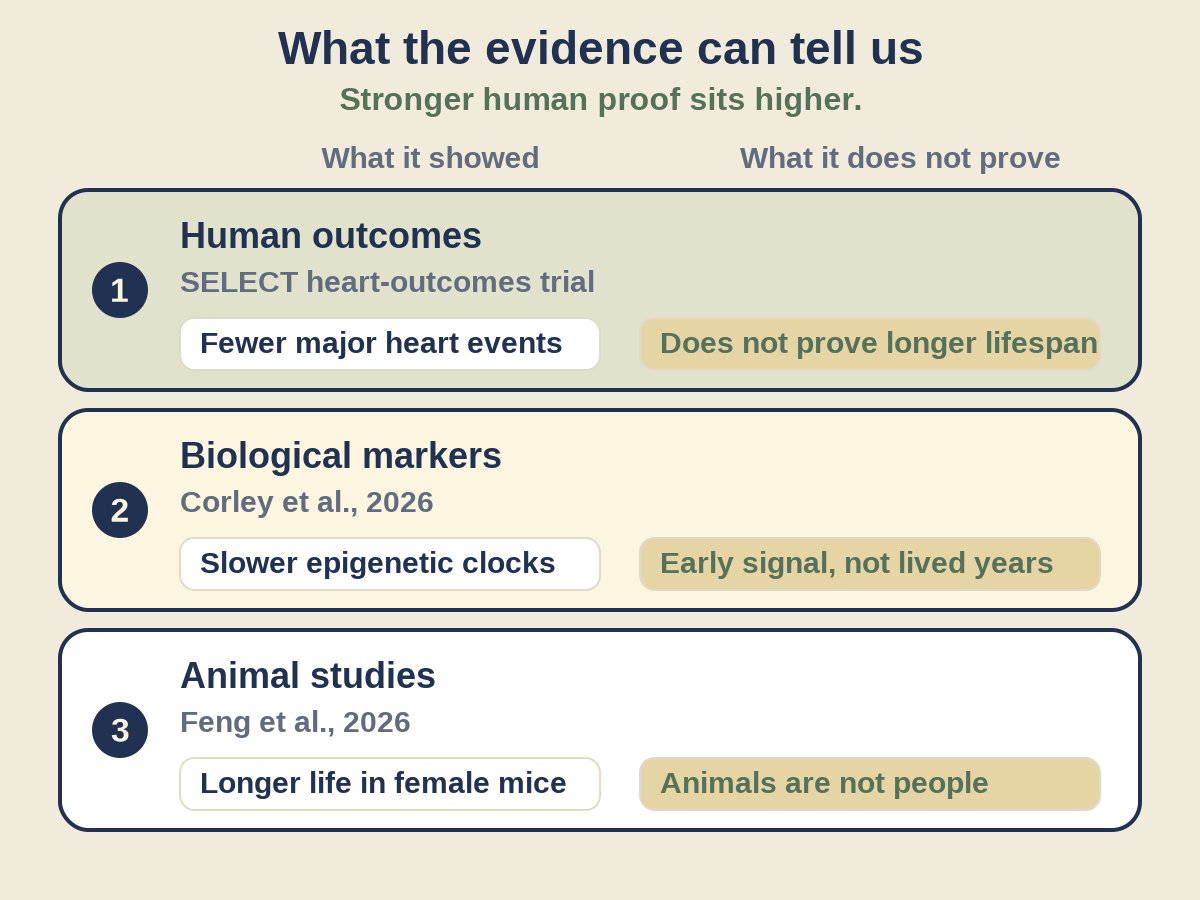
Evidence | What was measured | What it showed | What it does not prove |
|---|---|---|---|
SELECT (humans) | Major cardiovascular events over about 40 months | About 20% lower relative risk of heart attack, stroke, or cardiovascular death (composite) versus placebo in people with CVD plus overweight or obesity, no diabetes | That semaglutide extends lifespan in people generally |
Corley et al. (humans, exploratory) | Epigenetic aging markers over 32 weeks | Slower change on several DNA-methylation clocks versus placebo in an HIV lipohypertrophy cohort | That people became younger or will live longer |
Feng et al. (female mice) | Health measures and lifespan | Better late-life function and longer median lifespan versus control mice | That the same lifespan effect happens in humans |
The more useful conversation today is healthspan: lowering serious disease risk and supporting better health while you age, under a licensed clinician's care, for people who qualify, not buying a longevity drug.
How this fits weight management care
If you're thinking about a GLP-1 for weight management, talk with a provider about metabolic health, whether you qualify, and how the medicine usually sits with people like you. If you already have cardiovascular disease, the heart findings from trials of FDA-approved products belong in that conversation too. Living longer is still something researchers are studying, not something a clinic can promise.
Increase Health offers clinician-supervised compounded semaglutide and compounded tirzepatide for eligible patients as part of a weight management program. Those compounded medicines are not the products studied in SELECT, the epigenetic analysis, or the mouse lifespan work. Ask a licensed provider whether any GLP-1 is appropriate for you. For common side effects, see what to expect on a GLP-1.
When to get help
This page is educational and is not medical advice. Decisions about prescription treatment belong with a licensed healthcare professional. Seek urgent care for symptoms your care team has flagged as emergencies (for example severe allergic reaction, chest pain, or sudden neurological symptoms).
*Compounded medications are not FDA-approved. FDA does not review compounded medicines for safety, effectiveness, or quality. Findings from trials of commercially manufactured semaglutide should not be assumed to establish the safety or effectiveness of compounded formulations. Individual results vary. No outcome is guaranteed.*
Chief Executive Officer & Co-founder
Deangelo studied Education Studies at UC San Diego and leads Increase Health’s patient education and community, making wellness information clear and accessible. He is not a clinician: your care team and its licensed providers will make every treatment decision.
Related treatments
For adults 18+ in eligible US states. Evaluation does not guarantee a prescription. Only approved patients receive medication; patients pay $0 if not approved. Compounded medications are not FDA-approved.
 Compounded SemaglutideWeekly injection. $447 for 3 months (about $149 a month).
See If I Qualify
 Compounded TirzepatideWeekly injection. $669 for 3 months (about $223 a month).
See If I Qualify
Stylized product images for marketing purposes only; they do not reflect the actual label, size or number of the prescription containers.
Sources
- 1.
- 2.
- 3.
Related articles

GLP-1s and sleep apnea: what the tirzepatide trials showed
Weight Management · 5 min read

Protein and strength on a GLP-1
Weight Management · 7 min read

How to give yourself an injection at home
Weight Management · 8 min read