

In short: People write to Increase Health asking how much protein to eat on a GLP-1. We read a 2025 joint advisory from four US societies and built the calculator on this page from the range it discusses, about 1.2 to 1.6 grams of protein per kilogram of body weight a day1. Some of the weight reduction on these medicines is lean mass, not fat12. Without strength work, and if the weight comes back, that advisory says loss of muscle and bone can raise the chance of sarcopenic obesity: too little muscle for the weight a person is carrying1. The protein range is support for your health, not a guarantee you will keep every bit of muscle.
How much protein should I eat on a GLP-1?
That is the question we get most. Enter your weight in pounds or kilograms.
The calculator uses 1.2 to 1.6 grams of protein per kilogram of body weight a day. That is the range a joint advisory from the American College of Lifestyle Medicine, the American Society for Nutrition, the Obesity Medicine Association, and The Obesity Society discusses for this kind of treatment. The usual adult allowance is 0.8 grams per kilogram1.
Your daily range
Enter your weight in pounds or kilograms. We built this from the range in the 2025 joint advisory: 1.2 to 1.6 grams of protein per kilogram a day.
If you have kidney disease, protein in the urine, or an estimated glomerular filtration rate under 60, do not raise your protein until a kidney specialist has said so3.
One gram per pound is about 2.2 grams per kilogram. The advisory says protein should not stay at or above 2 grams per kilogram for a long time, and that scale weight can overestimate what you need when your weight is high1. Ask your care team before you aim for one gram per pound. That is why this calculator uses 1.2 to 1.6 grams per kilogram, not one gram per pound.
A dietitian may use a lower figure. One option both reviews mention, when scale weight would overstate the need, is a flat 80 to 120 grams a day13.
Spread the day over three or four feedings. About 20 to 40 grams at each one is a way to do that. It is a floor for a feeding, not a cap on the day. The calculator splits your range across four feedings. Vomiting is more likely after a large meal, and a lot of protein at once can slow the stomach further, so sip a shake between meals rather than saving the day for one plate1.
What Kelly and Dr. Olive said about protein
Kelly and Dr. Olive discuss nutrition in the MD Newsline video Why Protein and Strength Training Matter on GLP 1 Therapy4.
They say many telehealth companies and clinics hand over a GLP-1 with only a generic "eat healthy," and little about what that means. On these medicines, portions are small. In this discussion they say what you eat matters, because nutrients have to fit in less food, and protein matters.
In this discussion they use about 0.8 grams of protein per pound of ideal body weight or goal body weight. They often cap that around 140 grams a day when the goal weight makes the math hard to eat. They raise the amount slowly. They say people eating 50 to 60 grams a day are below what they use to limit muscle loss. They pair that protein with strength training.
Dr. Olive cites the NIH CALERIE study and places its first papers around 2018 and 2019. He says moderate calorie restriction was tied to molecular signals that help preserve lean mass, and that extreme dieting is a different case. He says people still need to be well nourished and to exercise. He says that observation may apply to GLP-1 medicines.
How do I eat enough when a few bites fill me?
The next question is how to eat that much when a few bites fill you. The hard part is usually the room on the plate, not the arithmetic. Protein-rich food comes first, and a shake or a fortified product when solid food will not do it1.

What helps you get there:
- Eat the protein on the plate before the rest of the meal1.
- Use foods that pack protein into a small volume: eggs, Greek yogurt, cottage cheese, fish, and poultry. Beans, lentils, and dairy count too. Keep red and processed meat smaller1.
- A shake can close the gap. So can a bar. When you are already full, a shake you sip is easier to finish than something you have to chew.
- If hunger is quiet, eat a small meal on a schedule, about every 3 to 4 hours, and set a reminder if you need one. Skipping the meal can make nausea worse1.
- Sugary drinks use up the little room you have. Water, or a protein shake, is a better use of it1.
- Constipation is common with these medicines. Protein can slow the stomach further, so add fiber from food gradually, such as beans, lentils, or dried fruit like prunes. Go easy on a big jump in fiber in the first days of a dose change1.
- Drink through the day, and more when you train or when nausea, vomiting, or diarrhea is present. Dehydration from those symptoms can injure the kidneys. One review's fluid target is more than 2 to 3 liters a day, matched to heat, health, and exercise13.
- Have the first shake in the morning, before you feel like eating, and sip a second one over an hour or two rather than all at once. A habit, not a trial finding.
- Keep two or three breakfasts and lunches you already know. Let dinner be the meal that changes. A habit, not a trial finding.
- A powder that is only collagen is not a complete protein. Count eggs, dairy, fish, poultry, beans, or a shake made from a complete protein toward the day's number. A habit, not a trial finding.
Tell your care team if "a few bites" is still all you can manage after the first weeks. Your care team decides any dose change. The side-effects guide covers nausea, fluids, and when to get help: GLP-1 side effects: what to expect and when to get help.
A small snack you already tolerate is enough before you train. If you feel light-headed during the session, stop.
What strength work can I do at home?
Protein on its own is not enough. That same review is why this plan is three strength days a week, plus at least 150 minutes a week of walking or other moderate activity, matched to what you can keep doing1. A walk on the days you do not lift can be that moderate activity.
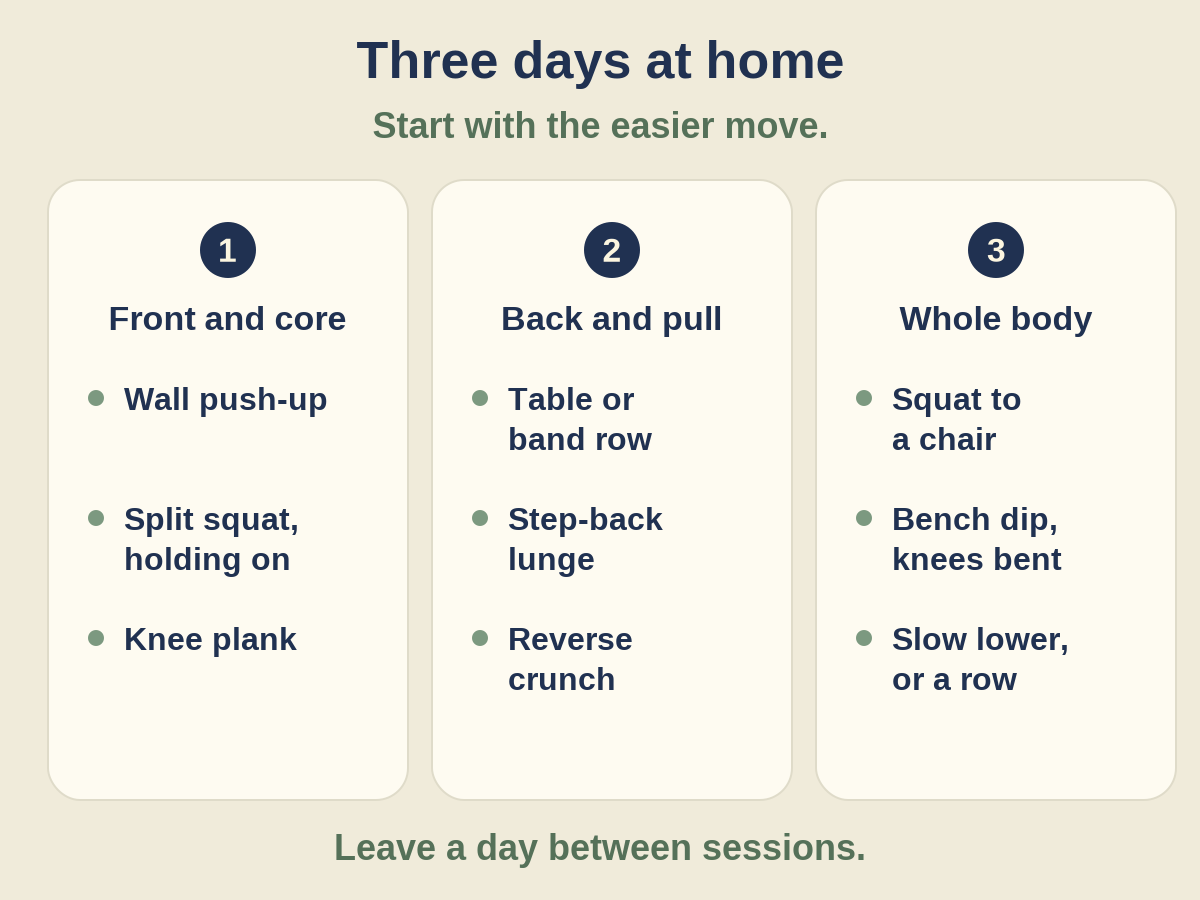
Do each move for 3 sets. Stop while your form is still steady, usually somewhere in 6 to 12 repetitions. For the plank, hold it from your knees only as long as the shape stays. Leave a day between the three sessions.
The easier version is the workout. Move to the harder one only when the easier one feels comfortable:
Day | Easier version | When that feels comfortable |
1. Front and core | Wall or counter push-up. Split squat while you hold a door frame, or a shallower knee. Plank from the knees | Incline push-up, then a dip. A deeper split squat. A plank from the toes |
2. Back and pull | Row under a sturdy table, or with a band. Step backward into a lunge, hands on a chair. Reverse crunch, lying on your back | A band-assisted pull-up. A forward lunge. A hanging knee raise, if you have a bar and it feels safe |
3. Whole body | Squat down to a chair and stand back up. Bench dip with knees bent and feet flat. A row, if you have no bar | A deeper squat. A stricter dip. A slow lower from a bar, only if you can get up to it safely |
The score to watch is whether those repetitions still go, not what the scale did that week. Strength work asks the muscle to stay. It does not promise that it will. In older adults who already have too little muscle for their weight, strength work has been tied to better strength and a steadier walk3.
What should I do the week my dose changes?
Keep the three days. Stay on the easier version that week, even if the week before felt fine. Stomach symptoms are more likely while a dose is changing1. What to do about them is in the side-effects guide. Do not add difficulty in a week when eating and energy are unsteady.
When should I stop and tell my care team?
Stop the session if you feel dizzy, if you are vomiting, or if a joint or your chest hurts. Call 911 for chest pain, trouble breathing, fainting, or severe belly pain that will not go away. Message your care team about a new pain that does not settle, and about any week you cannot eat enough to get near the low end of your range.
Chief Executive Officer & Co-founder
Deangelo studied Education Studies at UC San Diego and leads Increase Health’s patient education and community, making wellness information clear and accessible. He is not a clinician: your care team and its licensed providers will make every treatment decision.
Related treatments
For adults 18+ in eligible US states. Evaluation does not guarantee a prescription. Only approved patients receive medication; patients pay $0 if not approved. Compounded medications are not FDA-approved.
 Compounded SemaglutideWeekly injection. $447 for 3 months (about $149 a month).
See If I Qualify
 Compounded TirzepatideWeekly injection. $669 for 3 months (about $223 a month).
See If I Qualify
Stylized product images for marketing purposes only; they do not reflect the actual label, size or number of the prescription containers.
Sources
- 1.
- 2.
- 3.
- 4.
*This guide is general information and doesn't replace advice from your care team. The calculator range and the training plan come from expert reviews of GLP-1 treatment, including studies of FDA-approved medicines. Compounded medications are not FDA-approved; FDA does not review them for safety, effectiveness or quality.*
Related articles

GLP-1s and sleep apnea: what the tirzepatide trials showed
Weight Management · 5 min read

Do GLP-1s help you live longer?
Weight Management · 4 min read

How to give yourself an injection at home
Weight Management · 8 min read